Protected work
This case study is password protected. Enter the password to continue.
Have a copy of my resume? You'll find the password on it.
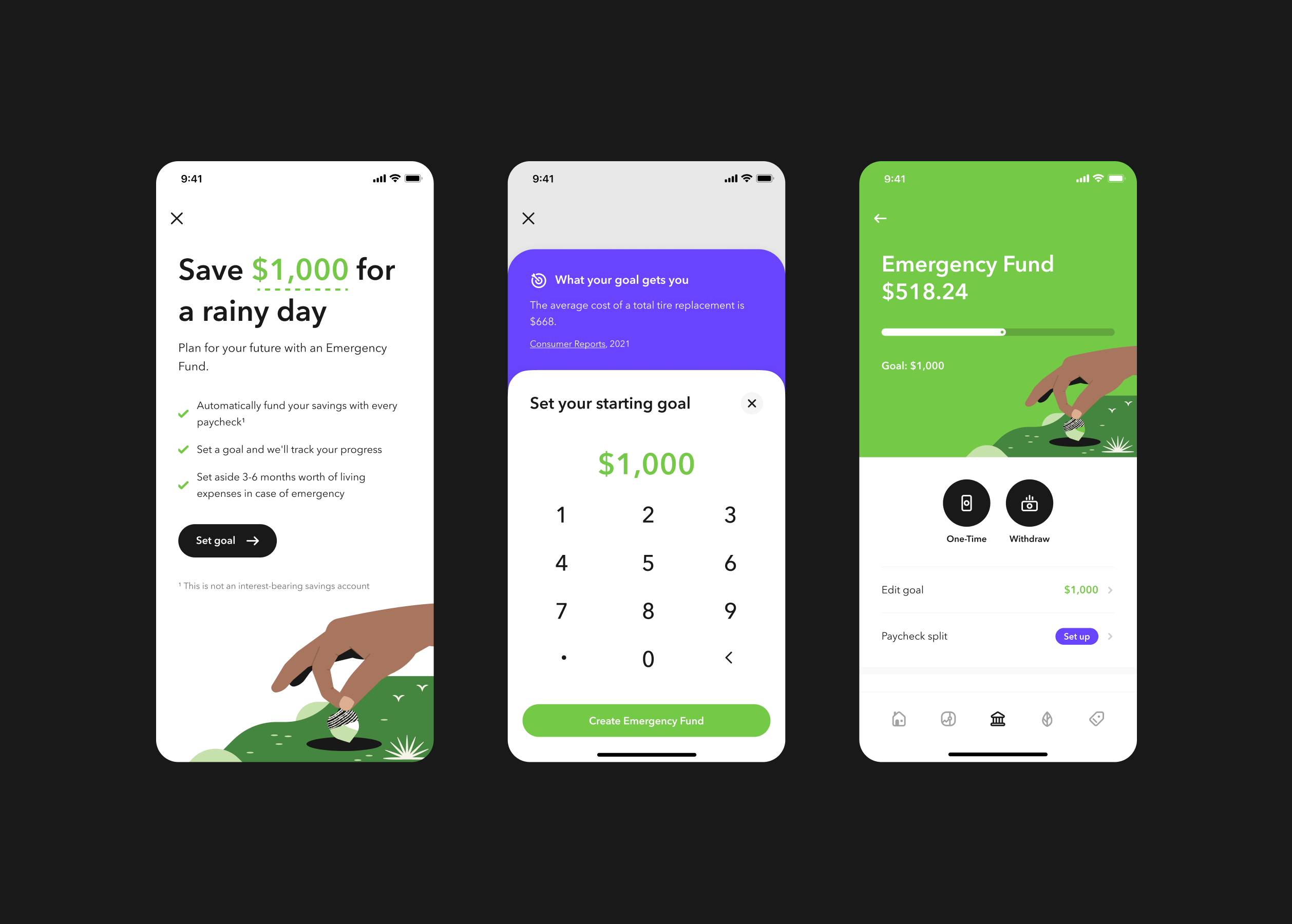
Building a savings system from 0 to 1
Team: Product Design Lead (myself), Product Manager, Engineering Manager, Copywriter.
Acorns offers a range of financial products, anchored by its investment account. Through ongoing research we found customers were using that investment account for short-term savings and emergencies, despite the market risk and tax friction of withdrawing from it. One of Acorns' core tenets of financial wellness is that people should have funds to draw on in an emergency before they invest. The Emergency Fund was our answer.
How might we support our customers' short-term saving needs?
This challenge spanned two teams: Investment Products and Banking. The Investment team focused on educating customers on the purpose and best practices of an investment account, while the Banking team focused on meeting customers' actual savings needs.
Working with our banking partners, we determined we could offer an additional bank account to our existing checking customers. While functionally near-identical to a checking account, we could position and market this one specifically for savings.
The opportunity: give customers a dedicated, low-friction place to build a financial cushion, before an unexpected expense forces them to pull from investments.
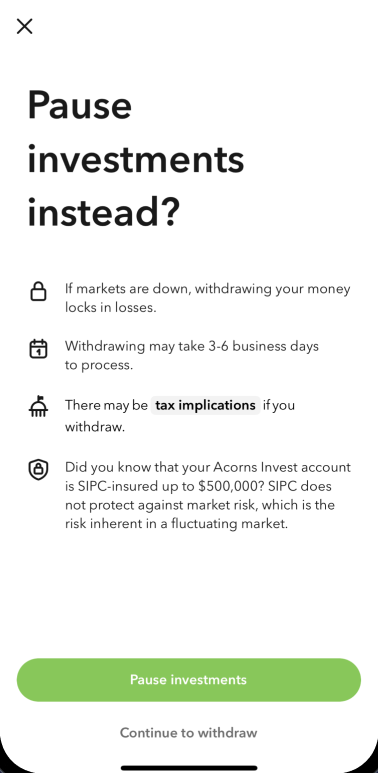
shipped by the Invest team.
Process
Recurring user research surfaced a clear pattern: customers were using their investment account as a stand-in savings account, parking short-term cash and emergency money somewhere that carried market risk and tax friction.
We interviewed customers across their saving and spending cycles and partnered with both the Investment Products and Banking teams to understand where a dedicated, lower-risk savings product could fit.
We explored a spectrum of solutions, from a lightweight savings goal layered onto existing accounts to a fully separate bank account. Working with our banking partners, we landed on an account that was functionally similar to checking but framed and marketed specifically for savings.
That framing decision shaped everything downstream, from the guardrails we'd need to the scope we could realistically ship.
We prototyped the goal-setting, funding, and withdrawal flows and put them in front of customers to pressure-test comprehension and intent.
These sessions surfaced an early signal that the account's purpose wasn't fully landing, a thread we would keep pulling on through every iteration that followed.
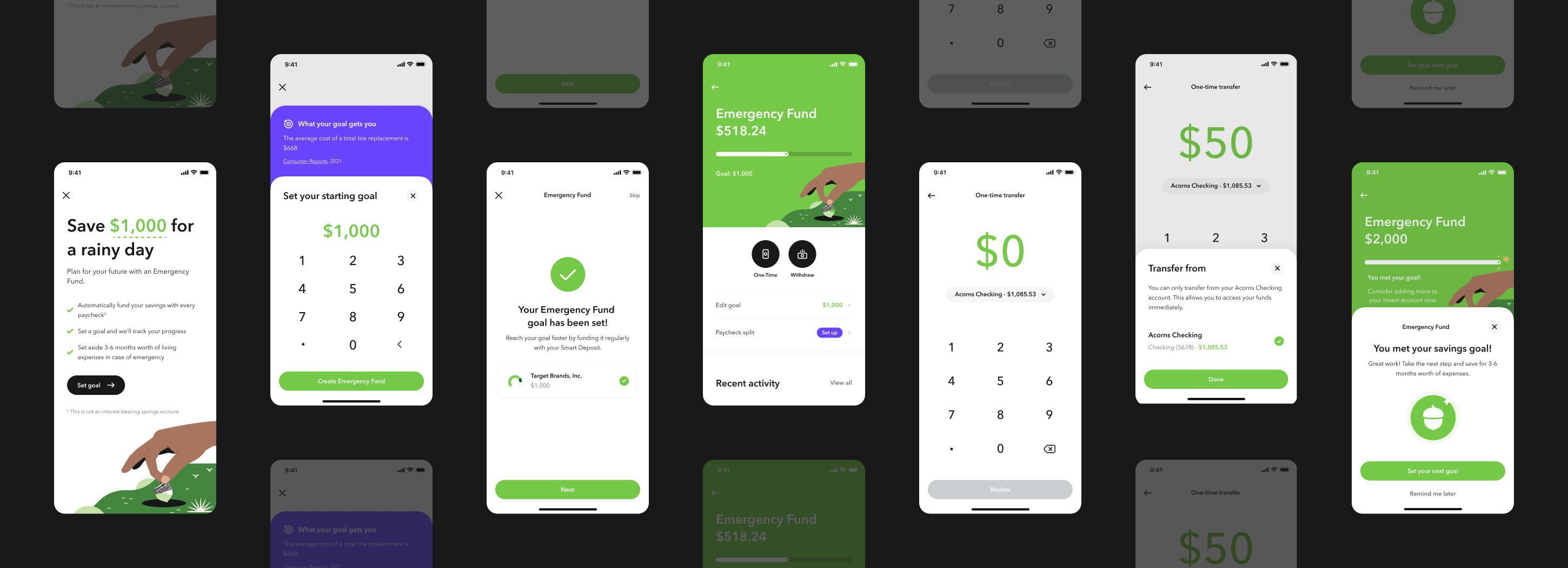
We shipped an MVP to eligible customers with multiple entry points, branded goal-setting, multiple funding options, a product home, and goal editing.
We instrumented the launch to tell us quickly whether the core savings behavior was actually forming, rather than waiting on the full vision to learn.
Challenges
This account was a net new product for Acorns, so even in its most simple version our engineering team estimated it would take 16 weeks of development time. I worked closely with my product and engineering partners to cut scope as much as possible and determine what was core to the experience and what could wait until post-launch.
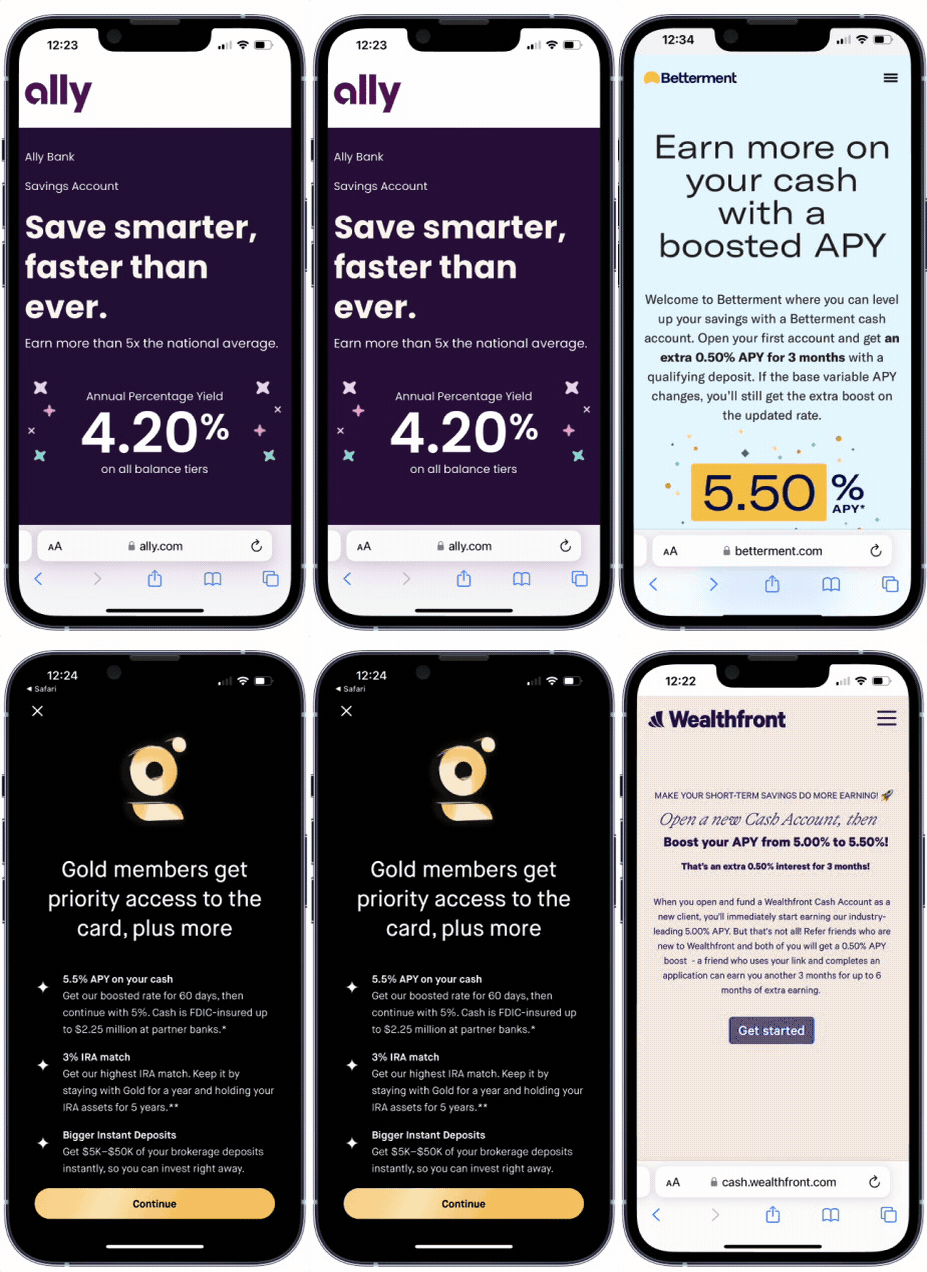
During this time the landscape of interest rates was evolving, with banks offering increasingly competitive rates, often exceeding 5% annual percentage yield on savings accounts. Ultimately we decided against launching with an APY feature, but remained attuned to customer feedback and competitive trends.
One of the biggest drivers of revenue for the Banking team was direct deposit. The idea was proposed to make using direct deposit a requirement to having an Emergency Fund. We hypothesized this would not only boost direct deposit revenue but also enhance the experience by streamlining ongoing transactions post-setup. After much consideration and discussion, we opted to gate the account behind direct deposit.
Success Metrics
- —Adoption of the Emergency Fund
- —Time to meet initial savings goal
- —Low average withdrawal rate
- —Increased adoption of direct deposit
First launch
The MVP version of the Emergency Fund included multiple entry points, branded goal-setting, multiple funding options, a product home, and goal editing. We deliberately cut scope to ship and learn rather than waiting on the full vision.
The MVP shipped to eligible customers, and the early data gave us a lot to work with.
The direct deposit number was encouraging, we were reaching customers who hadn't previously engaged with that feature. But the high withdrawal rate and near-zero goal completion told us users weren't treating this as a savings account.
They were opening one and drawing from it freely, often for non-emergencies. We had three hypotheses for why, and we tested each one.
Iterations
Over the following months we ran three targeted iterations. The first two moved the needle modestly. The third changed the picture entirely.
Our hypothesis was that users weren't connecting this account to its purpose. If it felt like a second checking account, they'd treat it like one. We tested adding intentional friction to the withdrawal flow with an optional questionnaire asking users why they were withdrawing. The goals were twofold: remind users that this money was meant for emergencies, and collect behavioral data to inform future decisions.
The withdrawal rate decreased slightly, but not enough to consider this a solution. The behavior was forming earlier in the experience, not at the point of withdrawal. That led us to look upstream, at how users were understanding the account from the start.
We shifted our hypothesis. Maybe the issue wasn't awareness of the account's purpose, but a lack of personal ownership over it. We tested customizable savings buckets, one of which could be designated for emergencies, with the goal of making the account feel more intentional and discouraging casual withdrawals.
Adoption and engagement improved modestly, but the withdrawal rate stayed high. Users were still not fully committing, and it became clear that something more fundamental was holding them back. The product strategy wasn't the problem, the offer was.
Through our research we had identified that competitors were offering strong APY rates on high-yield savings accounts. We were asking customers to set money aside and earn nothing on it.
Offering a competitive APY had been on the table from early on, but there were real concerns. Rates were high at the time and expected to come down, and leadership worried it would read as a gimmick. If rates dropped and customers saw their return shrink, they might blame Acorns even though that was outside our control.
After much discussion and research, we determined we could and should do it anyway. Putting money back in customers' pockets was not a gimmick, it was a tangible benefit with real impact on their financial lives, and it was what the product needed to be taken seriously as a savings vehicle.
With the introduction of 5% APY, we saw nearly a 200% increase in product adoption.
The Emergency Fund launched with modest traction and a high withdrawal rate. Through three rounds of iteration we narrowed in on the real blocker. We had designed around the assumption that customers wanted one centralized place for their money, and believed a well-designed product would be enough to earn that loyalty.
What we learned is that a great product experience couldn't compete with a better financial offer. Customers would shop around, and they should. A competitive APY addressed the real need directly, driving a nearly 200% lift in adoption and turning the Emergency Fund into one of the Banking team's strongest growth levers.